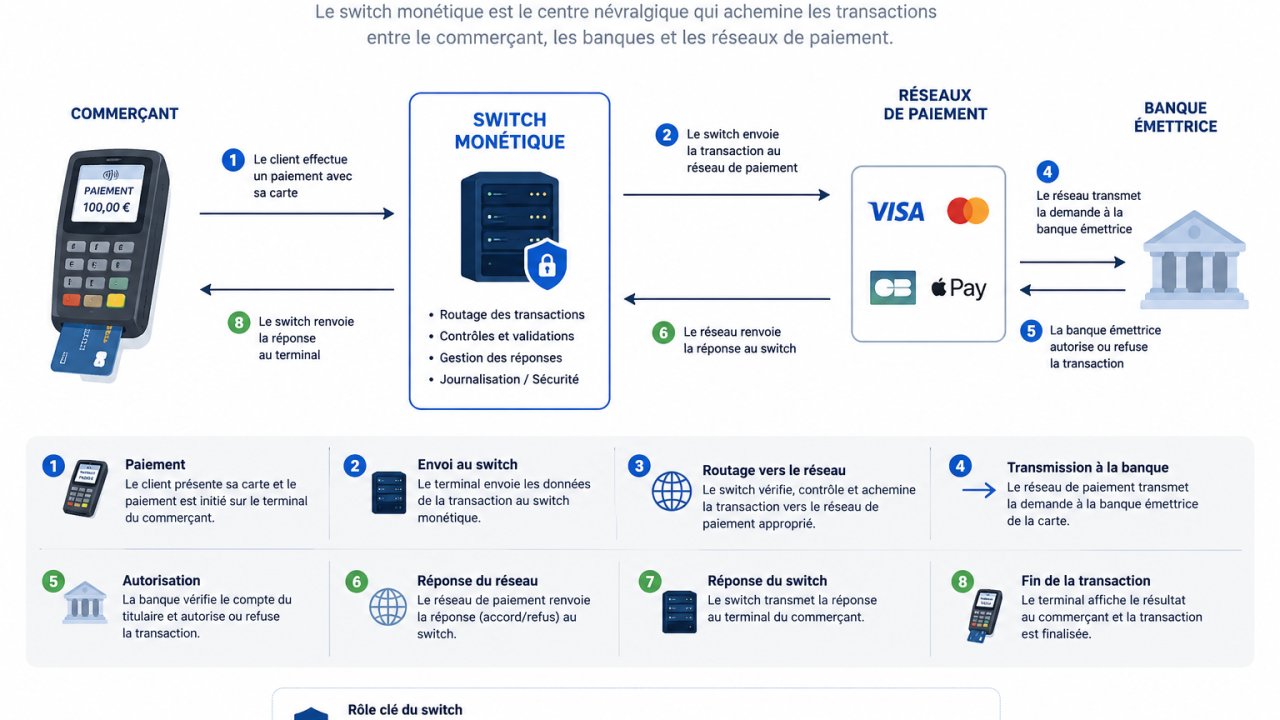
What is a payment switch?
You are on holiday, far from home, after a busy year. Your bank card is the magic wand that lets you enjoy the treatment you deserve. Each withdrawal far from your bank's home market triggers substantial technical work behind the scenes. An invisible referee checks with your bank whether to serve you. In a blink, the ATM, online payment site or POS terminal knows whether the transaction should proceed. This article explores the role of payment switches.
Example: an intelligent telephone switchboard
As usual, a small analogy helps. Imagine a large company with a central switchboard. When someone calls, it asks who they want, which department and whether the call is authorised, then connects them to accounting, management, technical support or security. The switchboard does not handle the request itself: it directs it to the right person and returns the answer.
The payment switch
A payment switch works like an extremely fast payment switchboard: it receives a transaction, identifies the destination, routes it, retrieves the response and returns it to the terminal, all within milliseconds.
It is a central IT platform that receives, analyses, routes and transmits electronic transactions between payment participants. It is one of the most important components of a bank's payment ecosystem.
It acts as an intelligent intermediary between:
• POS terminals;
• ATMs;
• mobile applications;
• issuing banks;
• acquiring banks;
• networks such as Visa and Mastercard;
• sometimes Mobile Money platforms.
Its main role is to deliver every transaction to the right system for an approval or decline.
How a payment switch works
A customer pays by card at a supermarket. The switch receives a request: this card wants to pay CFA 25,000 at this merchant; can it be authorised?
The switch analyses:
• Which bank issued the card?
• Is the transaction domestic or international?
• Should it go to the internal system?
• Should it go to Visa?
• Is there an anti-fraud rule to apply?
It sends the request to the right recipient, receives an approval or decline, and returns it to the terminal within seconds.
A payment switch therefore performs the following functions.
Routing transactions
It uses the BIN to identify the appropriate destination: a card from the same bank, a domestic card, international card or mobile wallet. This is transaction routing.
Translating messages
Each system may speak a different language. The switch converts formats, often ISO 8583, like a universal translator—just as I am writing this post in French for my audience.
Applying business rules
Each bank may have its own business rules or regulatory constraints: limits, operating hours, geographic restrictions, security checks and fraud scenarios. Cards issued in CEMAC, for example, face restrictions outside the region. If I travel to China with my current card, I will have less freedom even with sufficient funds. Banks implement these checks on their switches.
Logging operations
The switch keeps a complete transaction trail for audits, reconciliation, reporting and dispute management.
Enabling interoperability
A switch communicates with other switches and institutions: banks, card networks, Mobile Money operators, fintechs and wallets. It enables interoperability between them.
4. Types of payment switch
Internal bank switch
Not every card transaction goes outside the bank. Transactions at my own bank's ATMs, POS terminals or website are handled by an internal switch.
National switch
Some countries, with a sense of monetary sovereignty—I will leave that aside—have national switches connecting banks within the country. This is domestic interoperability.
Regional switch
A regional switch extends the national model across several countries. GIMAC is an example.
International switch
This handles international transactions and connects to major networks such as Visa, Mastercard and AMEX.
5. The regional switch: GIMAC
GIMAC enables:
• CEMAC interbank connectivity: a card issued in Chad should work easily in Cameroon or Gabon;
• less external dependence: avoiding routing all transactions outside the region;
• lower service costs: fewer international commissions;
• faster financial inclusion: banks, microfinance institutions, Mobile Money operators and fintechs can transact directly with one another.
A regional switch also faces challenges:
• heterogeneous banking systems;
• technical issues, including network connectivity;
• cybersecurity;
• regional governance and coordination between central and commercial banks, regulators and processors.
Nevertheless, the future lies in unified switches joining banks, Mobile Money and microfinance. GIMAC made this strategic choice. Its value is clear: a customer in Chad could pay a merchant in Cameroon through Mobile Money on one infrastructure.
Summary
The payment switch is the invisible conductor of electronic payments.
It does not create money, determine balances or necessarily store accounts. It ensures that each transaction reaches the right place at the right time with the right response. Without it, the modern payment ecosystem cannot operate efficiently.
We have reached the end of this article. I hope it was useful. I welcome your views and comments, and you can like or repost it to reach a wider audience.
#MobileMoney, #Monétique, #DigitalBanking, #SwitchMonétique