🌟 What is money? 1/4
You are young and working, so you are already chasing money. But what exactly is it? This short series is my contribution to financial education for our community. We will later return to card payments and Mobile Money.
Two analogies
1. Cowrie shells
Mr Djoret grows beans, Douskréo grows maize and Mrs Ronel sells fish. If Djoret wants maize and Douskréo wants beans, they can agree exchange quantities. Problems arise when needs are not reciprocal: Djoret wants fish, but Ronel does not want beans. This is barter, an ancient and restrictive system.
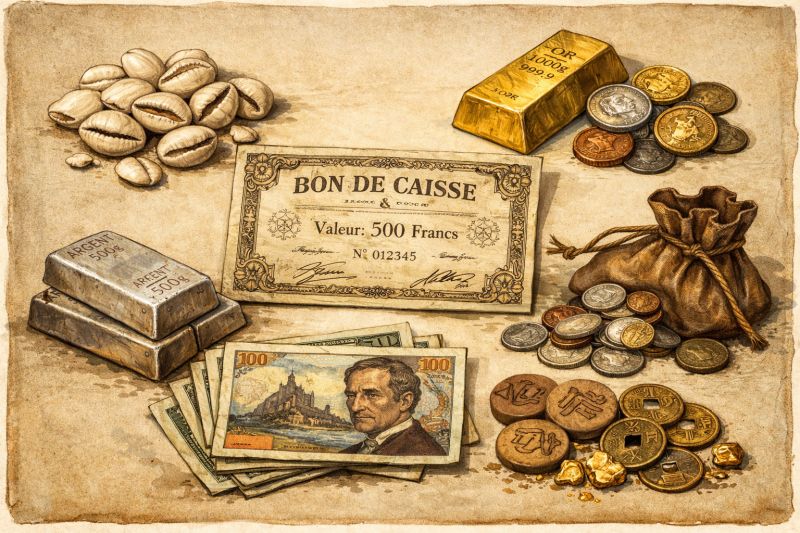
To solve this, everyone agrees on a rare object accepted as an intermediary. Cowrie shells, retrieved from the water, take this role and become money. They have no value themselves but quantify the value of beans, maize, fish and other products.
2. Credit vouchers at the CA7 bar
Bokhit regularly visits a cosy CA7 bar for grilled mackerel and Gala beer. Once again, the owner claims there is no change, trying to take advantage of him. This time he insists on a document allowing him to claim the change later. He receives a small credit voucher showing the amount owed. On his next visit, he can pay with it. Within that bar, vouchers perform money's role as a medium of exchange.
Bokhit can give a voucher to a friend who can use it for fish at the same bar. What gives cowries or vouchers value is their users' shared trust. Nobody eats cowries, for example. But unanimous acceptance in exchange for clothes, livestock and food gives them value.
If the entire country were one big bar where we could eat and drink—calm down, I know—is money not, at some point, simply an acknowledgement of debt issued by the bar?
The next post will discuss how money is created and who participates. Please share if you enjoyed this post.