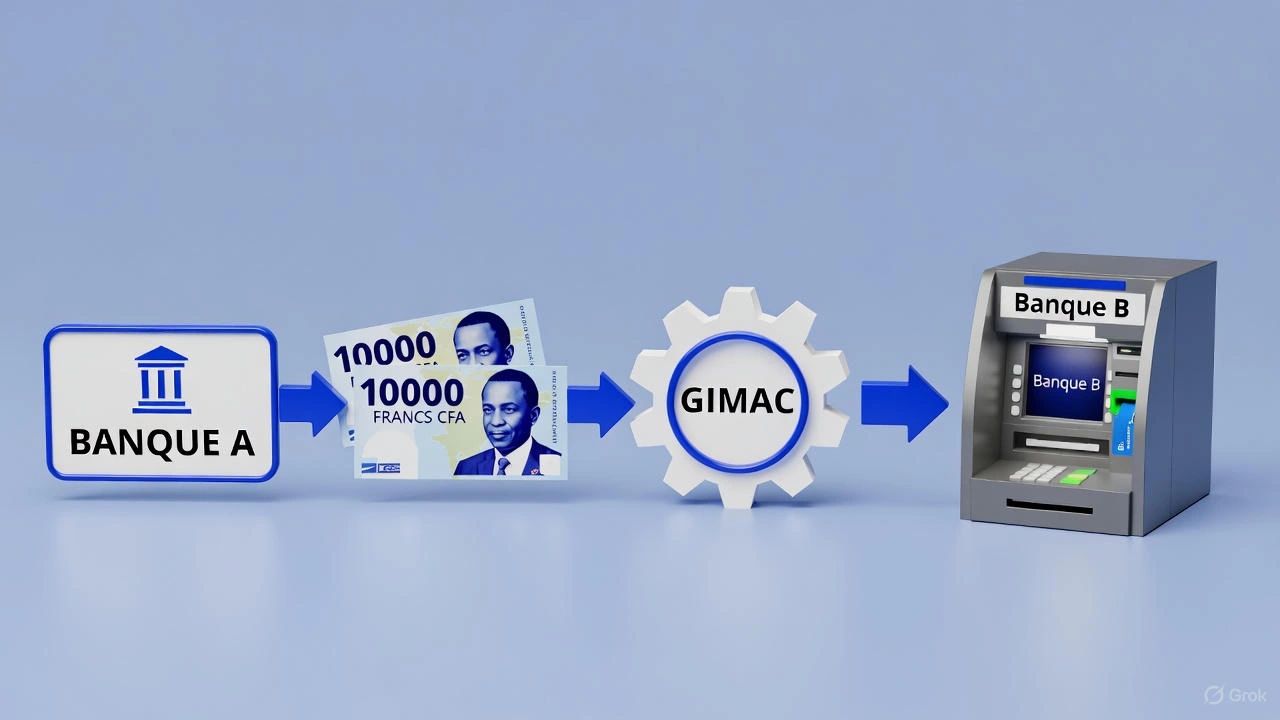
OFF US AND ON OFF TRANSACTIONS
Good evening, dear community. Let's discuss withdrawals at other banks, assuming banks A and B share the CEMAC monetary area.
A small analogy
Lamna wants to borrow CFA 20,000 from Ramou and says he has money at home to repay it. Ramou asks for a guarantee. Their friend Nerambaye offers to act as referee and personally ensure repayment.
Withdrawing at another bank
You effectively borrow that bank's money on the understanding that your own account can cover the withdrawal. From a bank's perspective, other banks' customers withdrawing with us are OFF US; our customers withdrawing elsewhere are ON OFF. These are two sides of the same situation.
The transaction
A bank A customer wants to withdraw at bank B:
• The customer submits identification and amount.
• The request goes to the referee, GIMAC in Central Africa.
• GIMAC sends it to the customer's bank for authorisation.
• The bank approves or declines after checks.
• Approval reaches bank B, which dispenses the cash.
• GIMAC later arranges repayment to bank B.
For bank A, this is ON OFF. It debits the withdrawal plus fees and holds the amount in an internal account for later reimbursement to bank B.
For bank B, this is OFF US. The customer has no account there, so an internal account is debited to fund the ATM. It is later balanced by funds from bank A.
Reconciliation
At day-end, GIMAC calculates what each bank owes the other. If A owes B ten million and B owes A eight million, A sends only the two-million difference.
Notes
• Withdrawals in one monetary zone are cheaper because they use the same currency.
• If a problem arises, contact your bank, which raises the complaint with GIMAC.
That is a brief explanation of OFF US transactions in one currency. Share your experiences: I welcome your views and comments.
#GIMAC, #OFFUS, #DigitalBanking, #Monétique