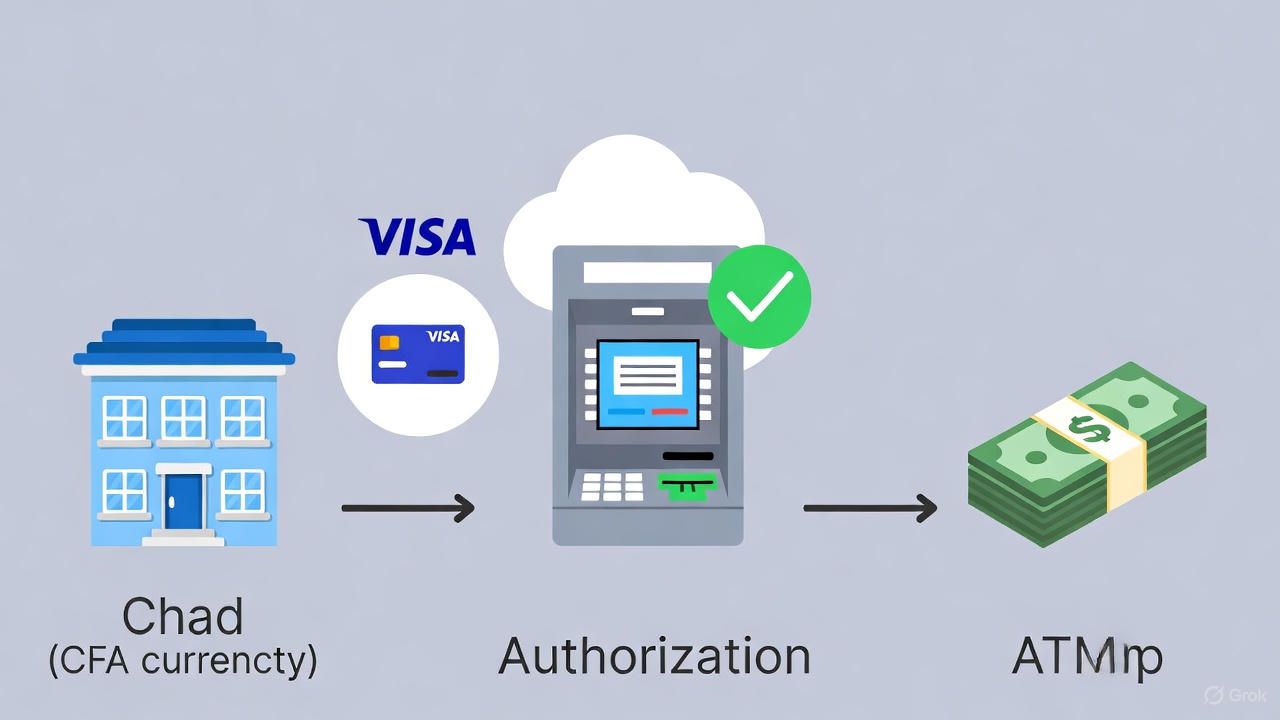
INTERNATIONAL ATM WITHDRAWALS
Dear community, let's conclude our ATM series.
As explained earlier, withdrawing from another bank effectively means borrowing its money. Before serving you, it checks your ability to pay by requesting authorisation from your bank. Your bank generally debits your account for later reimbursement to the bank advancing the funds.
How does authorisation work outside your monetary zone—for example, a Chadian bank customer withdrawing in China with Visa or Mastercard?
Authorisation steps
1. The cardholder authenticates and requests a withdrawal.
2. The ATM sends the details to its Acquiring Authorisation Server, AAS, which routes them to the Issuer Authorisation Server, IAS, through Visa or Mastercard.
3. The issuer checks details, balance, anti-fraud rules and limits.
4. The IAS returns approval or decline through the same network and AAS to the ATM. The customer is served accordingly.
5. The issuer often sends an SMS or email with amount, location and time to help detect fraud.
6. Transactions are aggregated for clearing and settlement through Visa or Mastercard to debit your account and credit the acquiring bank.
The first four steps generally take a few seconds.
Tips
• Withdrawing outside your monetary zone is always more expensive. Your bank reimburses the money advanced and includes a margin beyond its commission to manage exchange-rate effects. Reimbursing a Chinese bank requires foreign currency.
• For CFA-zone countries, withdrawals in the euro area are more affordable than in other monetary zones because of the fixed euro–CFA parity.
• Most banks offer apps for balance checks. Checking through Visa/Mastercard can generate a network charge to your bank, which may pass it on to you.
A like or share would be appreciated if you enjoyed this post.
#digitalBanking, #monétique, #banque, #ATM, #GAB