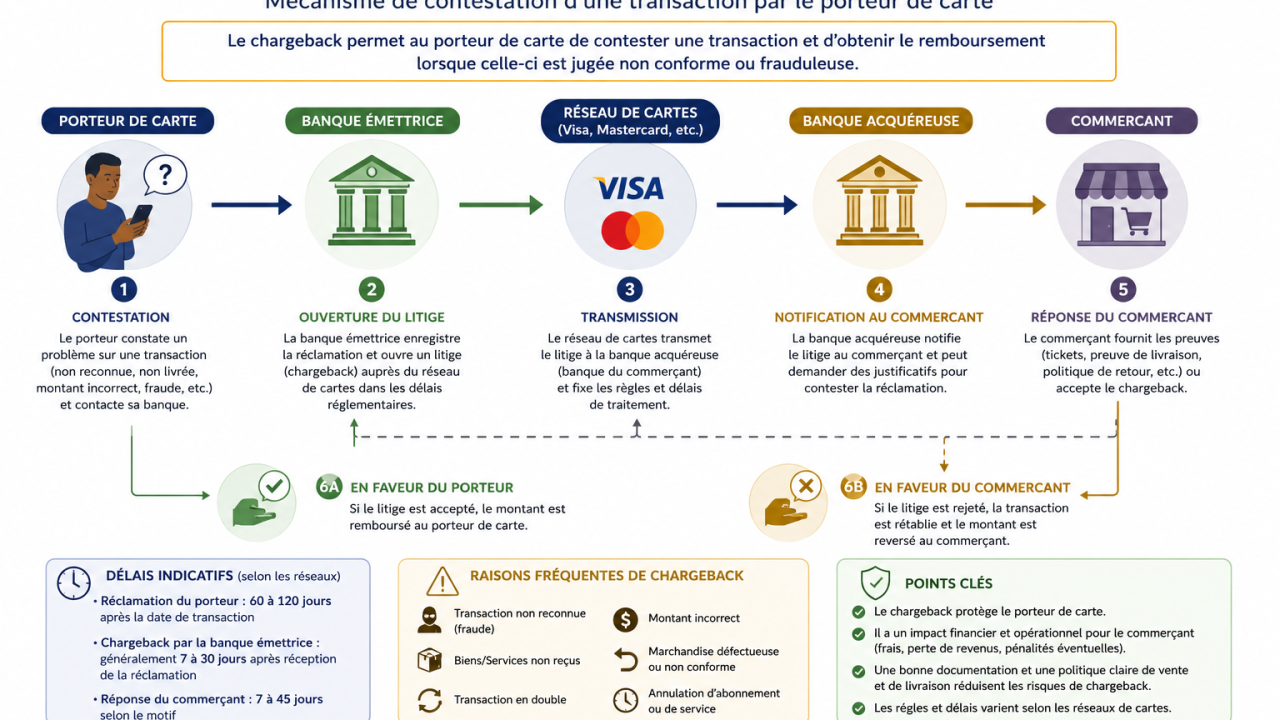
A chargeback is a procedure that allows a card-issuing bank to dispute a card transaction and recover funds from the acquiring bank when a transaction is fraudulent, erroneous or inconsistent with payment-network rules.
It is a cardholder-protection mechanism provided by international networks such as Visa, Mastercard, American Express and Discover.
The chargeback lifecycle
The main actions in a chargeback lifecycle are:
1. The customer pays by card.
2. The merchant is credited.
3. The customer disputes the transaction.
4. The issuing bank opens a case.
5. A chargeback is sent to the acquiring bank.
6. The merchant responds, accepting or disputing it.
7. A final decision is made.
8. The final debit or refund is processed.
Main participants
The participants generally include the cardholder, issuing bank, acquiring bank, merchant and payment network, such as Visa or Mastercard.
Main reasons for a chargeback
1. Fraud: the most common reason, including a stolen or cloned card or an unauthorised online payment.
2. Goods not received: the customer paid but never received the product.
3. Service not provided: a cancelled hotel booking or flight, an inactive subscription, or an incorrectly performed service such as a duplicate debit or incorrect amount.
4. Credit not processed: the merchant promises a refund but never makes it.
5. Processing error: a duplicated transaction, POS-terminal error or authorisation-system error.
Evidence used
Merchants may provide evidence that a payment was not fraudulent: a signed receipt, invoice, proof of delivery, booking confirmation or 3-D Secure authentication.
The stages
Stage 1 — Complaint: the customer contacts their bank.
Stage 2 — Analysis: the bank checks the applicable deadline, reason and supporting documents.
Stage 3 — Chargeback: the amount is debited from the acquiring bank.
Stage 4 — Representment: the merchant may respond with evidence.
Stage 5 — Pre-arbitration: the banks continue exchanging their arguments.
Stage 6 — Arbitration: the payment network makes a final decision.
A practical example
You buy a computer online for CFA 750,000. A few weeks later, you complain to your bank, claiming that you never made the purchase.
Your bank, the issuer, may block the card because fraud is suspected, open an investigation and initiate a chargeback request.
The computer merchant's bank, the acquirer, asks the merchant for transaction evidence: an invoice, signature or proof of delivery.
Two outcomes are possible:
• The merchant does not respond despite reminders. The chargeback is considered accepted, and the merchant is debited to refund the customer.
• The merchant supplies evidence: DHL delivery proof, a signature or 3-D Secure authentication. The chargeback is rejected.
How can chargebacks be reduced?
Handling chargebacks has a cost: investigation time, resources, chargeback fees and customer experience. It is therefore important to reduce these incidents as much as possible.
For banks:
• Deploy real-time fraud-detection tools.
• Expand strong authentication, including 3-D Secure where applicable.
• Monitor high-risk transactions.
• Educate customers about payment security.
For merchants:
• Keep sales and delivery evidence.
• Describe products and services clearly.
• Use an easily recognisable bank-statement descriptor.
• Handle refund requests promptly.
• Verify customer identity for high-risk transactions.
Deadlines
Deadlines vary by payment network and dispute reason, but generally range from 45 to 120 days for initiating a chargeback, with additional time for response, pre-arbitration and arbitration.
Good practices for a bank
A bank should establish:
• a dedicated card-disputes team;
• a chargeback-tracking system with performance indicators: volumes, turnaround times and success rates;
• fraud-analysis and document-management tools;
• procedures aligned with payment-network rules and regular staff training.
Effective chargeback management protects customers while limiting financial losses, fraud risks and possible payment-network penalties.
Have you experienced a card transaction that required a chargeback? I would be interested in your views and experiences.
#fintech, #digitalbanking, #reconciliation, #chargeback, #refund, #reversal