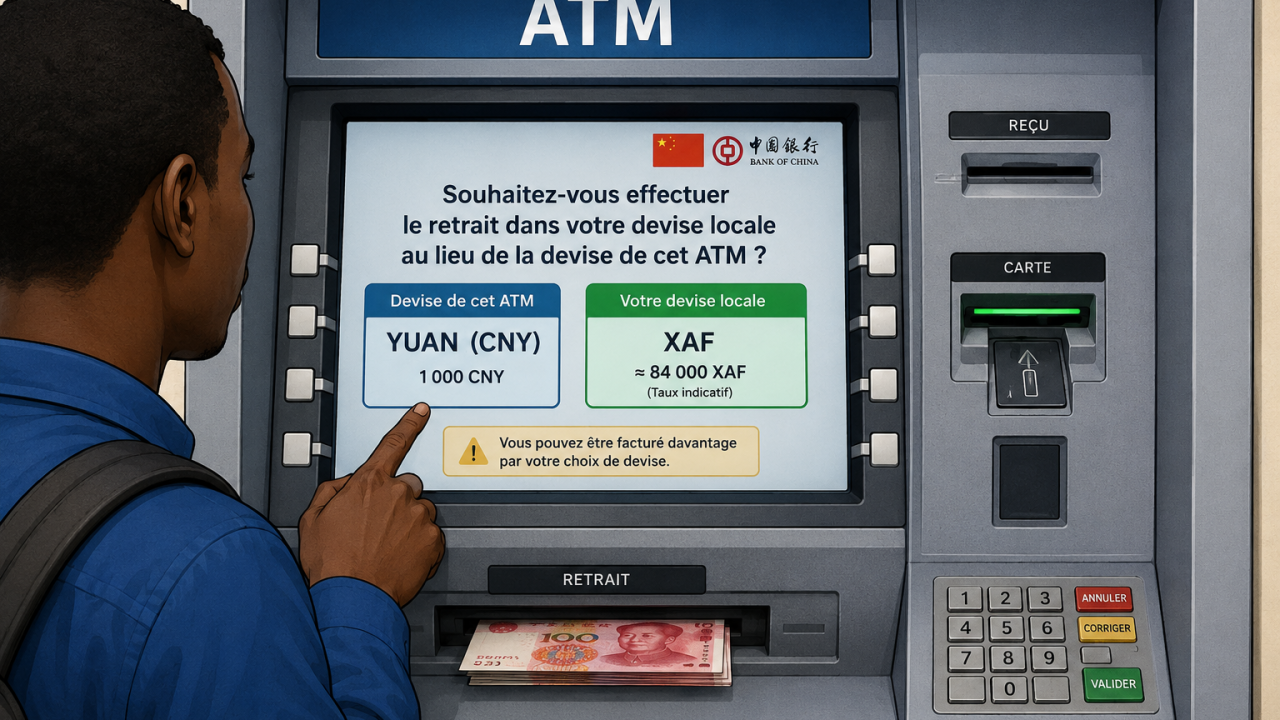
Bank cards are convenient: they save us from carrying cash when travelling, especially abroad where the currency differs from our own. Some ATMs ask which currency we want to use for the transaction. Should we choose the destination country's currency or our own?
Behind this seemingly harmless question lies a banking detail that can be expensive and that many people overlook. Let's unpack it.
The scenario
You are travelling in China and insert your card into an ATM to withdraw cash. After entering the amount, a message appears:
Would you like to be charged in yuan (CNY) or in your home currency (XAF)?
The question seems harmless and even reassuring. That is the trap: you may think that choosing your own currency tells you exactly what you are paying.
Many travellers instinctively select their home currency, believing it is safer. Yet in most cases it is the costlier option.
The mechanism behind this question is Dynamic Currency Conversion, or DCC. Understanding it helps avoid unnecessary charges and explains how international payment networks handle currency conversion.
The tourist-restaurant analogy
On arriving in Shanghai, you visit a restaurant to try Chinese cuisine. The friendly hostess offers two menus:
• Local version: CNY 100.
• Special foreign-visitor version: XAF 13,500.
The waiter suggests choosing the XAF menu because it will simplify payment at the terminal. It seems convenient. But the price uses the restaurant's own exchange rate: nothing guarantees that CNY 100 is worth XAF 13,500 that day. The rate often includes a markup.
Choose CNY 100, and your bank applies the actual market rate. Choose XAF 13,500, and the restaurant sets the rate. Do not blame your bank for that choice.
DCC works the same way: the merchant becomes a currency exchanger. You often pay more for apparent convenience. The same happens at an ATM.
What actually happens
Suppose you want to withdraw CNY 1,000 in China.
The ATM recognises a foreign card through its BIN, the Bank Identification Number: the first digits identifying the issuer. BINs are generally six digits but are moving to eight because of scarcity. IT specialists who experienced IPv4's transition to IPv6, or telecom engineers adding digits to phone numbers, will recognise the situation.
Reading the BIN, the ATM spots a business opportunity: this is not a Chinese card; I can offer conversion. It presents two options.
Option 1: be charged in the local currency, CNY
This is generally the better option.
The ATM dispenses CNY 1,000 and sends the transaction to your international card network, such as Visa or Mastercard. These networks use competitive interbank rates close to real market conditions. Your bank converts the amount into XAF using the network rate and any international charges or exchange-rate adjustments.
For example, if the actual rate is CNY 1 = XAF 84, the debit is XAF 84,000, plus any service charges.
Conversion follows a standardised and generally optimised process.
Option 2: be charged directly in XAF
Here DCC comes into play. The ATM operator performs the conversion, choosing its own exchange rate and margin, sometimes with an additional hidden commission.
The same CNY 1,000 may cost XAF 91,500 plus fees. You paid at least XAF 7,500 extra for the convenience of using your home currency.
Why does this mechanism exist?
It is highly profitable and generates revenue for the ATM operator, acquiring bank and conversion technology provider.
Its business model rests on a psychological promise: turning uncertainty into perceived comfort. The customer thinks, I can see exactly what I will pay, so I am in control of my spending.
Why even professionals fall for it
Even banking and finance professionals sometimes fall into this trap because ATM interfaces influence decisions.
Typical wording includes:
• Guaranteed exchange rate.
• Recommended conversion.
• Secure exchange rate.
• Lock your exchange rate.
These expressions imply security and an advantage, and you fall for the offer.
What happens at the issuing bank?
Choosing the destination's currency does not mean zero fees. Your bank still charges you because a Chinese bank has advanced the money and must recover it from your account. Choosing DCC adds an extra cost for apparent convenience.
The same principle applies at merchants
DCC is not limited to ATMs, as the tourist-restaurant example shows. You may encounter it at hotels, e-commerce sites and payment terminals. The best reflex is the same: decline the offered conversion and pay in the local currency.
4. A simple rule to remember
When travelling, always choose the currency of the country you are visiting.
In China, pay in CNY; in Europe, EUR; in the United States, USD.
Wording such as guaranteed conversion, instant conversion or payment in your home currency often conceals DCC.
5. Closing thoughts
A small ATM question reveals a larger truth: apparent simplicity often hides a complex architecture of intermediaries, margins and commercial optimisation. What looks like a service is not necessarily one. Taking back control of financial decisions can start with selecting Continue in local currency.
Have you noticed this question when withdrawing cash or paying abroad? Did you know that the choice could significantly change the actual transaction cost?
I would be interested in your views and comments. As always, a share or like would help this page reach more people and contribute to financial education.
#DigitalBanking, #Fintech, #Banque, #Bank, #MobileMoney, #DynamicCurrencyConversion