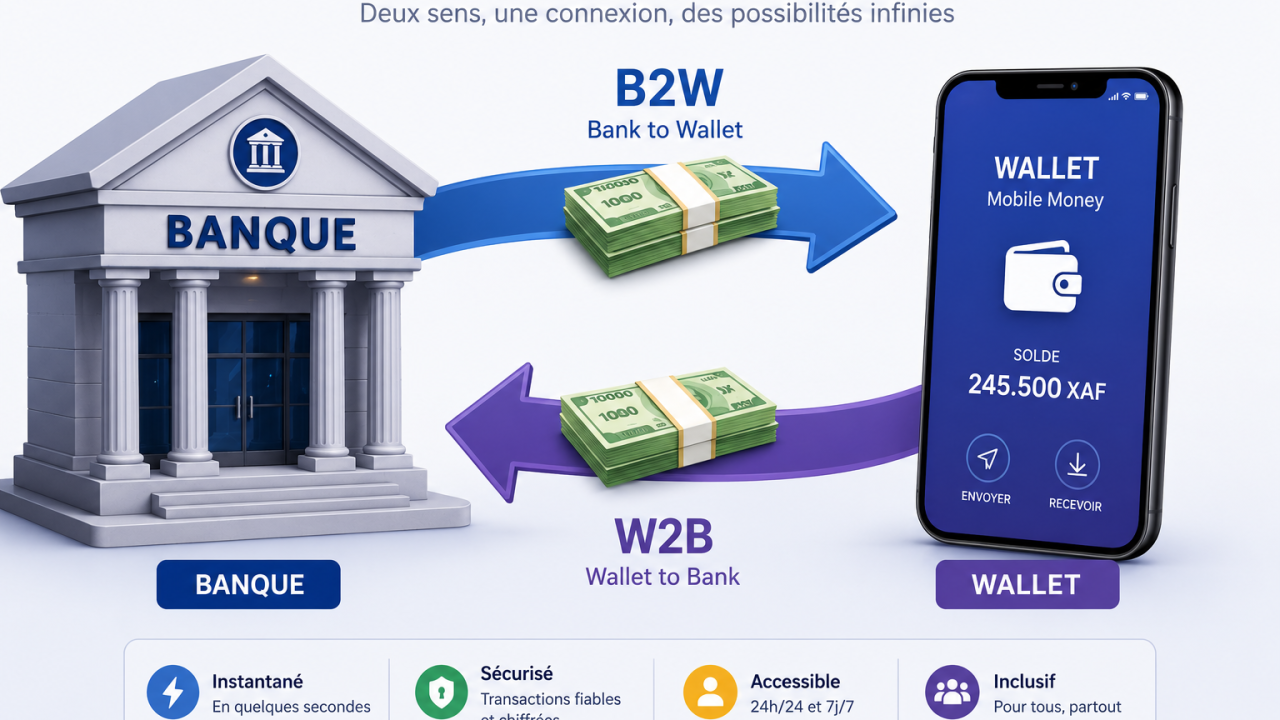
For a long time, banks and Mobile Money operators were seen as competitors. Today, that view has changed. The future belongs to ecosystems where bank accounts and electronic wallets communicate seamlessly, securely and instantly. GIMAC is stepping up its advocacy among financial institutions for greater interoperability, which is no longer a luxury but a necessity for accelerating financial inclusion and improving the customer experience.
What is a Bank to Wallet transaction?
A Bank to Wallet (B2W) transaction allows a customer to transfer money from a bank account to a Mobile Money wallet.
Examples include:
• funding a Mobile Money wallet from a banking app;
• transferring money to a relative's wallet;
• instantly topping up a Mobile Money account for everyday payments.
Advantages
✅ Funds available within seconds.
✅ Less use of cash.
✅ A better user experience.
✅ Access to Mobile Money services without withdrawing cash first.
What is a Wallet to Bank transaction?
Conversely, a Wallet to Bank (W2B) transaction transfers funds from a Mobile Money wallet to a bank account.
This is particularly useful for:
• depositing a merchant's takings;
• transferring savings to a bank account;
• funding an account used to receive a salary or make transfers;
• preparing a large bank payment.
Benefits
✅ Keeping funds secure.
✅ Access to conventional banking services.
✅ Building a banking history.
✅ Better integration between digital financial services.
How does a transaction work technically?
Integration through a payment switch, such as GIMAC
Although architectures vary across countries, the principle is similar:
• the customer initiates the transaction;
• the bank or Mobile Money operator authenticates the customer;
• the request is sent through an interconnection platform: a national switch, interoperability hub or technical partner;
• compliance checks are performed: KYC, AML, limits and available funds;
• accounts are debited and credited;
• both parties receive real-time confirmation.
The entire process generally takes a few seconds.
Direct integration between a bank and a Mobile Money operator
In Central Africa, banks and Mobile Money operators appeared to be a little ahead of the regulator. They integrated directly to offer B2W and W2B services to customers. The regulator has since caught up, and this trend will eventually fade. In this arrangement, transactions are handled directly between the bank and Mobile Money operator rather than through the switch. Mobile Money operators therefore open bank accounts for these transactions:
• For B2W, customers' bank accounts are debited to credit the Mobile Money operator's account. The banking system notifies the operator, and the customer's wallet is credited instantly.
• For W2B, the operator has already debited the customer's wallet and notifies the bank. The bank then debits the operator's bank account to credit the customer's account.
Main challenges
Success depends on several factors:
🔹 Robust technical interoperability.
🔹 Strong security mechanisms: strong authentication, encryption and fraud monitoring.
🔹 Highly available platforms, 24/7.
🔹 Efficient settlement between participants.
🔹 A simple, intuitive user experience.
Why are these services strategic?
Bank ↔ Wallet transactions help to:
✔ Accelerate financial inclusion.
✔ Connect banked and unbanked populations.
✔ Encourage electronic payments.
✔ Reduce cash circulation.
✔ Create new business models for banks and Mobile Money operators.
In several African countries, these services have become a pillar of financial-sector digital transformation: banking penetration is generally low, but almost everyone has a phone.
Conclusion
The future of payments lies in the complementarity of banks and Mobile Money. Allowing B2W and B2W already breaks down institutional boundaries: customers of institution A effectively become customers of institution B. Money circulates more freely.
Have you used your financial institutions' B2W and W2B services? What benefits or difficulties have you experienced? I would be interested in your views.
#Banking #MobileMoney #Payments #DigitalBanking #Fintech #Interoperability #FinancialInclusion #BankToWallet #WalletToBank #Monétique #Innovation #Africa #DigitalPayments